

 The Semiconductor Physics research group (“SemPhys”) is part of the Department of Physics at the University of Strathclyde. The Department is a member of the Scottish Universities Physics Alliance (SUPA).
🔬 Research sub-groups
Semiconductor Quantum Electronics (SEQUEL)
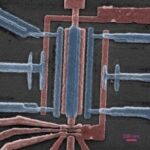
- Semiconductor nanoscale systems
- Quantum computing and quantum electrical metrology
- Electrical initialisation and readout of spin qubits in SiC
- Empowering Practical Interfacing of Quantum Computing (EPIQC)
- See sequel.phys.strath.ac.uk
Advanced Materials Diffraction (AMD) lab

- Advanced electron diffraction of semiconductors and crystalline materials
- Techniques include electron backscatter diffraction and electron channelling contrast imaging
- Characterisation of crystal defects and crystal properties (structure, elastic strain, (mis)orientation, crystal polarity)
- See amd.phys.strath.ac.uk
Gallium Oxide Optoelectronic Devices (GOOD)

- Wide bandgap semiconductor and defect characterisation
- Ultraviolet (UV) detection technologies
- Low-cost production of UV sensing materials
- See good.phys.strath.ac.uk
Experimental Quantum Nanoscience Lab (EQNL)
- Physics and applications of polariton condensates in microcavities
- Solid-state quantum systems for quantum information and nanophotonics
- Hybrid polariton-quantum dot platforms for scalable quantum hardware
- See eqnl.phys.strath.ac.uk
Microscopy & Spectroscopy of Semiconductors
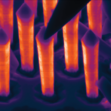
- Characterisation of UV-vis LEDs & microLEDs, transistors, solar cells, nanostructures, etc.
- Specialised capabilities in cathodoluminescence (CL), X-ray microanalysis (WDX/EDX), electron beam induced current (EBIC) and nanoprobing
- Innovative combinations of techniques to study the same micron-scale area
- See the Physics Electron Microscope Facility page
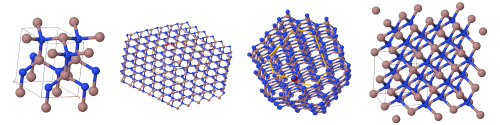
💎 Interactive crystal models
Explore crystal structures, lattice planes and dislocations
🥼 Join us! Jobs / PhD studentships available
- Funded PhD studentships are often available. See the different sub-groups for current vacancies.
📰 Group news
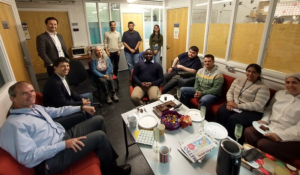 September 2026: Congratulations to Mugove Maruzanne on his successful PhD viva. It was also great to see his external examiner Dr Emilio Nogales Díaz back in Glasgow again after over 20 years.
- August 2026: The Roadmap on UV-C photodetectors: materials, applications and industry perspectives edited by Fabien Massabuau, with Fabien and Rob Martin within the author list, is now available on arXiv.
👉 https://lnkd.in/p/eVDYbE3z. - July 2026: The SEQUEL team joins a consortium of European partners to carry out a new EURAMET project named CRYO-RF: Cryogenic RF measurements for quantum and semiconductor technologies.
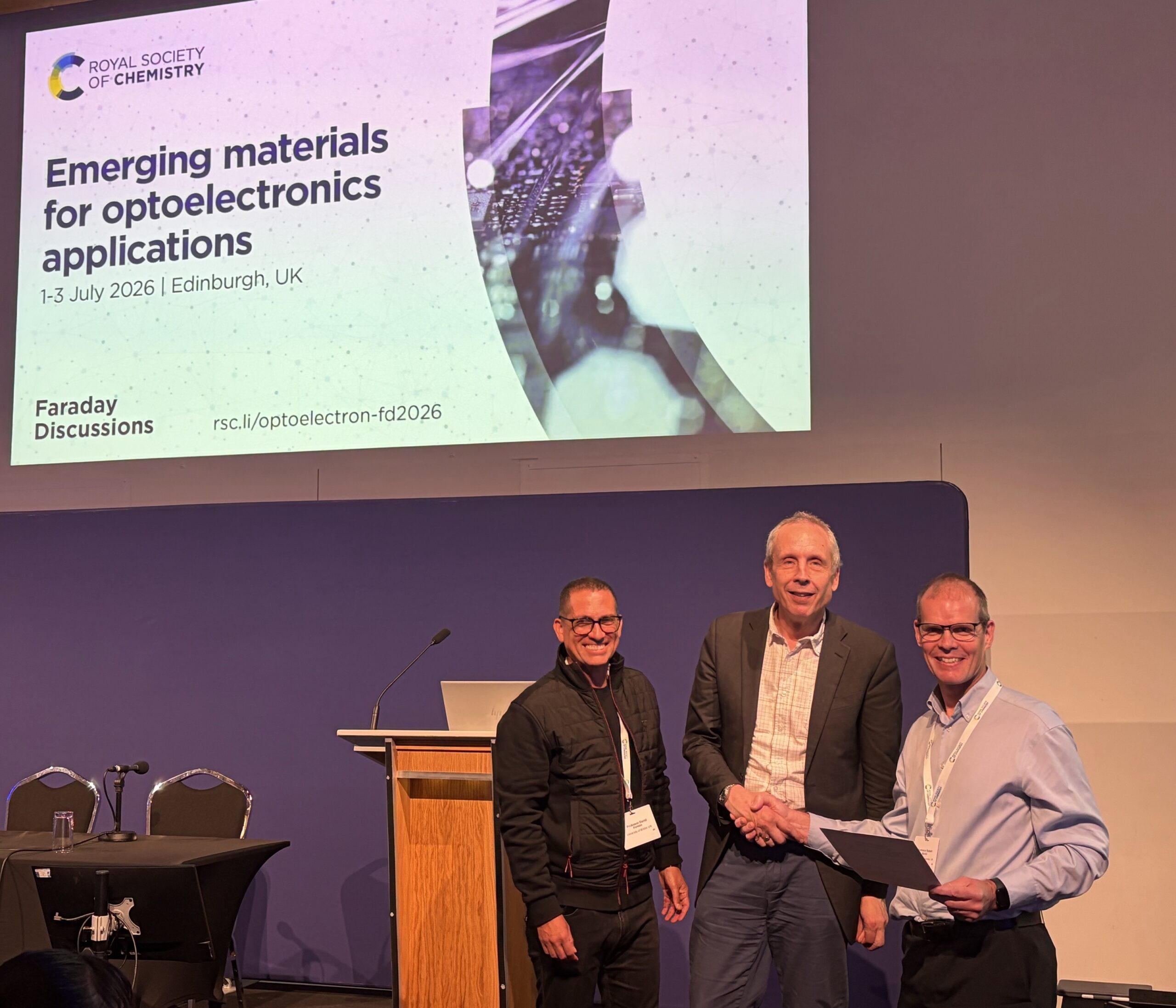 July 2026: Rob Martin presents the Spiers Memorial Lecture at the Faraday Discussions meeting on Emerging Materials for Optoelectronic Applications.
- October 2025: Well done to Stefan Nicholson, who has successfully defended his PhD thesis. His work on perovskite solar cells was undertaken jointly between SSD and the group of Dr Aruna Ivaturi in the Department of Pure and Applied Chemistry.
- September 2025: The SEQUEL team joins Quantum Motion and NPL for the EPSRC Prosperity Partnership project FIRETRACE to investigate thermal effects in cryogenic electronics.
- August 2025: Congratulations to Dr Alessandro Rossi whose UKRI Future Leaders Fellowship (QELTIC) received 3-year additional funding for developing cryogenic electronics in silicon carbide.
- March 2025: Congratulations to Dr Fabien Massabuau who has won the Materials Young Investigator Award.
- Older news items are archived here.
📖 Latest publications
-
![[doi]](https://semphys.phys.strath.ac.uk/wp-content/plugins/papercite/img/external.png) Movpe growth and characterization of alpn layers for hfets using ph3
Movpe growth and characterization of alpn layers for hfets using ph3 - Fabrication and characterisation of ga2o3 and gao(oh) particles synthesised by forced hydrolysis
- Complete coherent control of spin qubits in self-assembled inas quantum dots under oblique magnetic fields
- Spiers memorial lecture : emerging semiconductors viewed through the lens of a scanning electron microscope
- Imaging misorientation and strain of single dislocations in GaN using electron backscatter diffraction
- Controlling point defect populations in AlGaN deep UV LEDs
- Microanalysis of $\beta$-(AlₓGa₁₋ₓ)₂O₃ films grown by MOCVD
- Trion quantum coherence in site-controlled pyramidal InGaAs quantum dots
🧮 Crystallographic calculator
Convert between Miller and Miller-Bravais plane and direction indices, calculate angles between lattice planes, and obtain normal directions of planes in for cubic and hexagonal lattices. See here.